
A sound fleet maintenance plan starts with a risk-based register of every critical item on board. It then assigns an interval, a method, a responsible person and a record to each item, and schedules the work around the voyage rather than around the next inspection. For vessels calling at Australian ports, that plan is also what the Australian Maritime Safety Authority (AMSA) expects to see during Port State Control. This guide sets out how ship managers and technical superintendents can build one, which equipment needs particular attention, and where third-party testing fits.
TL;DR
- Build the plan from a risk-based asset register: critical equipment, manufacturer recommendations, defect history, ship age and the consequence of failure.
- AMSA has increased its focus on planned maintenance during routine Port State Control inspections, so records matter as much as the work.
- Lifting appliances, mooring winches and life-saving and fire-fighting equipment need dated, certified testing slots written into the plan, not added when a deadline appears.
- Track every defect from discovery to verified closure, and schedule rectification around port calls.
- Book specialist testing and inspection early in the planning cycle so parts, people and berth time line up.
Table of Contents
- What fleet maintenance planning means for a vessel fleet
- What AMSA expects from planned maintenance
- Build the plan in six steps
- Lifting appliances and safety-critical equipment
- Defects: capture, assign, verify, close
- Why detention risk should shape the plan
- Where specialist testing fits in the annual plan
- Our perspective
- Plan your next port-call testing with Nautix
- FAQ
- Sources
What fleet maintenance planning means for a vessel fleet
For road fleets, planning means oil changes and tyre checks. For ships it is a different discipline: equipment is remote from workshops, crews are small, and a failure can mean a detention or an off-hire day rather than a tow. Planning is the process of deciding in advance what will be inspected, tested, serviced or renewed, when, by whom, and with which spares.
The Fraunhofer Centre for Maritime Logistics describes the aim of maintenance management as balancing the cost of preventive maintenance or external services against the cost of equipment failure. It also notes that building maintenance into crew scheduling raises efficiency and helps keep work and rest hours compliant.
Lloyd’s Register’s 2025 white paper on condition based maintenance makes a related point: well-maintained ships suffer fewer unexpected failures, which reduces accidents, delays and disruption and protects the crews serving onboard.
What AMSA expects from planned maintenance
The ISM Code is implemented in Australia through the Navigation Act 2012 and Marine Order 58 (Safe Management of Vessels). AMSA’s Marine Notice 2024/08 states that AMSA has increased its focus on planned maintenance during routine Port State Control inspections. It also says a well-designed planned maintenance system, with regular maintenance, visual inspections and operational tests, reduces the risk of machinery failure.
Section 10 of the ISM Code sets out the structure an inspector will look for. The company must have procedures to ensure that:
- the ship is maintained in conformity with the relevant rules and regulations;
- inspections are held at appropriate intervals;
- non-conformities are reported, with their possible cause where known;
- corrective action is taken;
- records of all of this are kept.
The same section requires the company to identify equipment whose sudden failure could create a hazardous situation, and to promote its reliability through measures such as regular testing of stand-by equipment and systems not in continuous use. In practice, that is where emergency generators, fire pumps, lifeboat release gear and similar items belong in your plan.
Build the plan in six steps
1. Start with an asset register based on risk
IACS Recommendation 74 describes a systematic approach to maintenance that begins with a comprehensive register of machinery, equipment and fittings, based on risk assessment. The same document says the risk assessment should take into account:
- manufacturer recommendations;
- equipment history, including failures and defects;
- third-party inspection results;
- ship age;
- identified critical equipment;
- the consequences of failure for safe operation.
For each vessel, flag the items where failure would stop cargo work, compromise safety or invite a detention. Cranes, derricks, mooring winches, accommodation ladders, gangways, life-saving appliances and fire-fighting systems normally sit near the top of that list.
2. Set intervals, methods and acceptance criteria
The same IACS recommendation calls for defined maintenance intervals, inspection methods and frequency, the type of inspection and measuring equipment, acceptance criteria, qualified personnel and reporting requirements. A line in the plan that reads “inspect crane” is not enough. It should state what is checked, against which criteria, who signs it off and where the record goes.
Maritime New Zealand’s maintenance plan guidance is a useful structural reference even though it is a New Zealand document. It suggests listing every item to be checked and how often, covering hull, decks, machinery and critical systems, keeping a log of work done, describing requirements for at least the next five years, and listing preferred maintenance providers and shore-based contractors.
3. Choose preventive or condition-based maintenance item by item
Most fleets run a mix. Fixed-interval maintenance suits items where wear is predictable or where a statutory test date applies. Condition-based maintenance suits machinery where a measurable indicator shows developing failure.
The NorseTech white paper on reliability-centred and condition-based maintenance sets out when condition-based maintenance is worth adopting:
- the failure has significant consequences, such as safety, environmental, off-hire or high repair cost;
- a reliable measurable indicator of the developing failure exists;
- the warning interval is long enough to detect the problem and plan the work;
- monitoring costs less than the failures and fixed-interval work it replaces.
A 2025 CIMAC paper links condition-based strategies to cost savings, less downtime, improved engine performance and more predictable operations, alongside gains in safety and reliability.
Statutory tests and certificate-driven inspections stay on a calendar either way. Wire rope, brakes and lifting gear are examples where a recorded, dated test is the evidence an inspector wants.
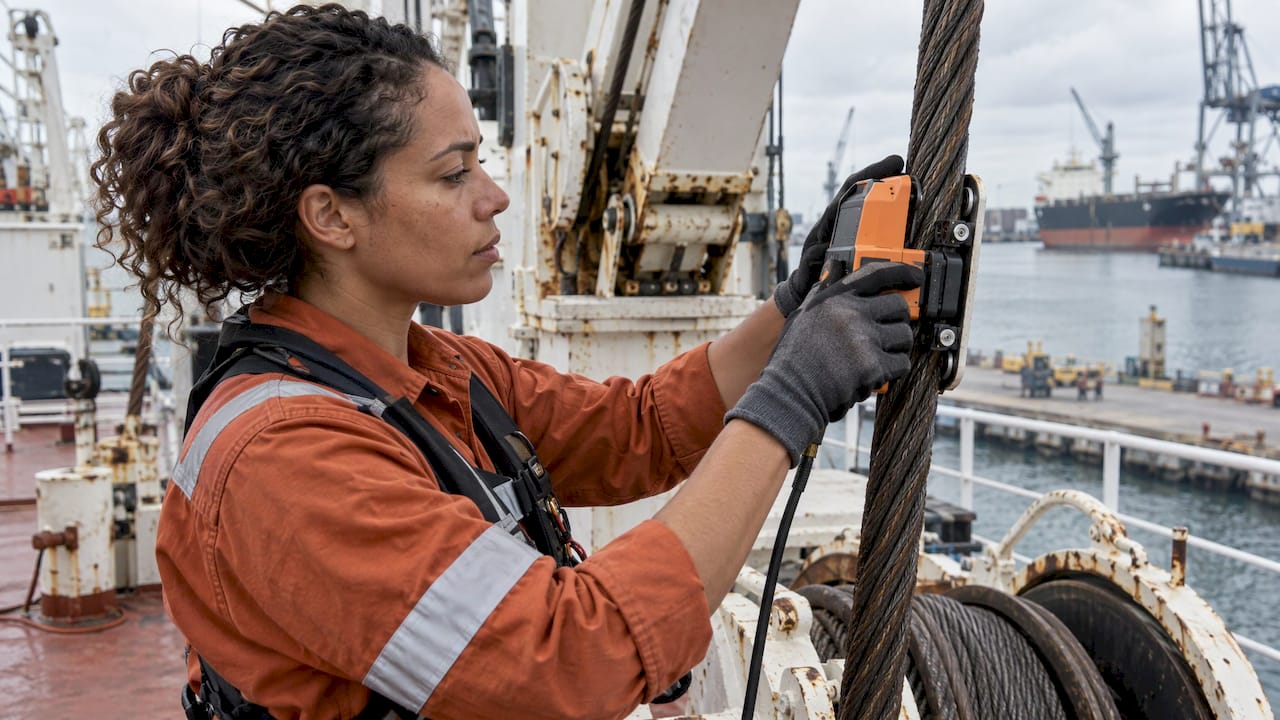
4. Fit the work to the voyage and the crew
Fraunhofer CML identifies the central scheduling challenge as finding intervals that prevent unplanned maintenance while distributing workload evenly across the voyage, so that rescheduling is avoided. Practical consequences for an Australian itinerary:
- Group shore-side testing with port calls where berth time already exists.
- Avoid stacking several major jobs in one port stay.
- Confirm the access, permits and crane or winch availability with the agent before arrival.
- Keep a buffer for the defects that testing is meant to find.
5. Plan parts and supply
AMSA expects operators to anticipate supply chain disruption and make provision for it when planning maintenance. Where spare parts cannot be provided, the operator should consult equipment manufacturers, the classification society and the flag State about appropriate measures (see Marine Notice 2024/08). Identify long-lead items such as crane wire, brake linings and lifesaving consumables when you set the annual plan, not when the test report calls for them.
6. Record everything
The ISM Code requires records, and an inspector will usually start there. A maintenance log, test certificates, defect closure evidence and correspondence with the class society should be retrievable by vessel and by equipment item.
Lifting appliances and safety-critical equipment
Lifting appliances deserve their own line in every plan because they combine statutory testing, wear and high consequence.
Flag-state requirements differ, so confirm the rule that applies to each vessel. Circulars effective from 1 January 2026 illustrate the common pattern:
- The St Vincent and the Grenadines circular SOL 076 specifies thorough examination by a competent person every 12 months, covering visual inspection and checks of certificates, SWL markings and gear condition. It also specifies a proof load test and thorough examination every five years.
- Barbados’ Bulletin 050 states that lifting appliances and loose gear are to be thoroughly examined after any load test and annually, with verification at the SOLAS renewal or annual survey where the examination is not part of that survey.
- The German flag State’s Circular 02/2025 says the master or company should appoint a person responsible for inspection, maintenance and testing of lifting appliances, with maintenance following manufacturer instructions and IMO and industry guidance.
These are flag-specific, and your own flag and class rules govern. The planning lesson is common to all of them: lifting gear needs an annual examination slot, a longer-cycle proof load test, a named responsible person and a complete paper trail.
A simple planning matrix
| Equipment | What the plan should hold | Typical planning trigger |
|---|---|---|
| Cranes and derricks | Annual examination, proof load test cycle, wire rope condition, SWL markings | Flag and class cycle, wire inspection results |
| Wire ropes | Condition assessment, renewal criteria, spare rope | Inspection findings, manufacturer discard criteria |
| Mooring winches | Brake rendering and holding capacity tests, maintenance routine | Class and company schedule, defects found at port |
| Gangways and accommodation ladders | Load test, visual inspection, certification | Certificate expiry, damage or repair |
| LSA and FFA | Periodic servicing, certificates, stand-by equipment tests | ISM stand-by testing, class survey |
Defects: capture, assign, verify, close
Planning fails quietly when defects are logged and then forgotten. A 2026 article on vessel defect tracking describes a five-stage lifecycle that works well as a template:
- Discovery and capture, with equipment ID, location, severity and photo evidence.
- Categorisation and routing by system and severity.
- Assignment and planning, where the superintendent decides on a work order, contractor requisition or class notification.
- Execution and evidence, including completion photos, parts used and time recorded.
- Verification and closure, with the superintendent checking the evidence and closing the item with an audit trail.
The ISM Code asks for the same logic: report the non-conformity, find the cause, take corrective action and keep the record.
Why detention risk should shape the plan
Shipping Telegraph reports that ageing fleets, tighter budgets, stretched maintenance windows and reduced crew capacity are leaving more vessels in a compromised state, particularly for safety-critical systems. The same report notes that even a short detention can escalate to six-figure costs once off-hire, berth costs, emergency repairs and insurance effects are counted.
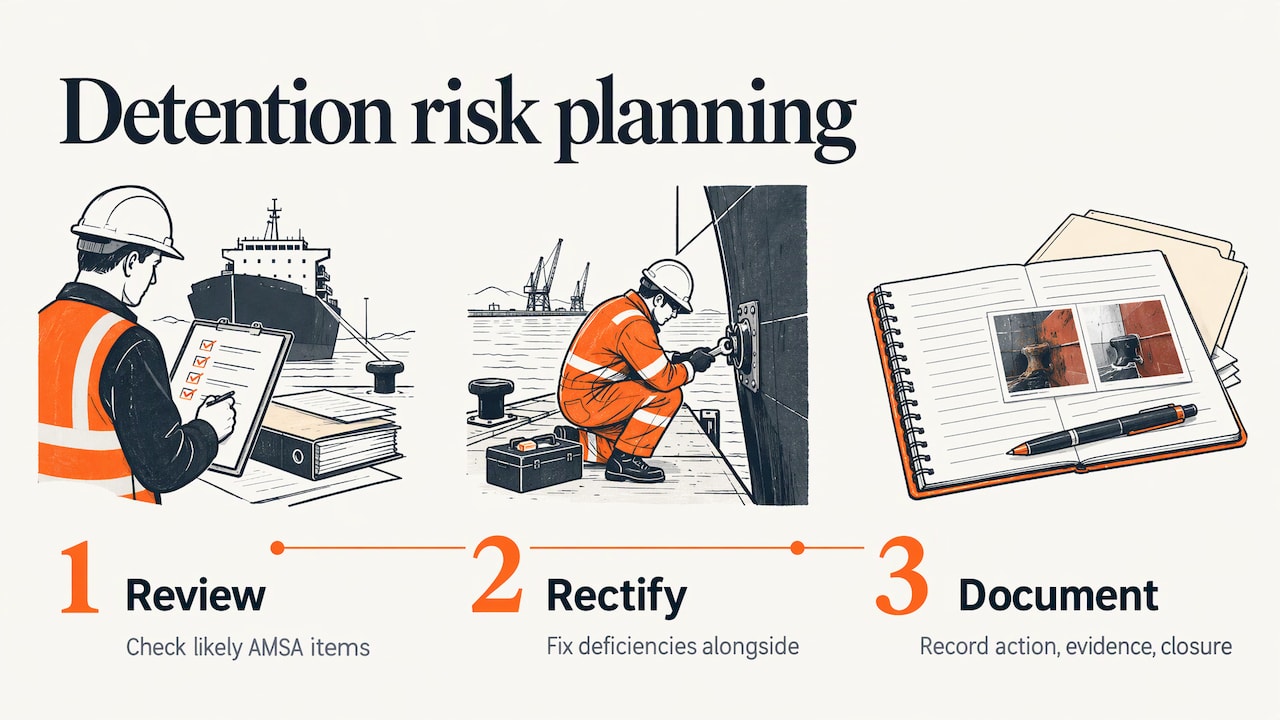
The cheapest place to find a deficiency is before the inspector does. That is the reasoning behind a pre-arrival review of the items AMSA is most likely to examine, followed by rectification while the ship is still alongside and the schedule is flexible. Our pre-AMSA inspection service is built around that sequence, with city pages for Sydney, Brisbane, Adelaide, Port Hedland and Dampier.
Where a deficiency is found, AMSA defect rectification keeps the corrective action, evidence and closure in one documented process.
Where specialist testing fits in the annual plan
A practical annual plan separates work the crew performs from work that needs specialist equipment, qualified personnel and a report that stands up to class, flag or AMSA review. Typical external items include:
- crane inspection, wire renewal and load testing;
- marine load testing, including water bag load testing, gangway and accommodation ladder testing;
- mooring winch brake rendering tests and winch inspection and maintenance;
- LSA and FFA inspection and servicing;
- wire rope Magnetic Rope Testing.
For what a load test certificate should show and how it relates to the plan, see our guide to load test certification.
Our perspective
Most maintenance plans we see on board are sound on paper. The weak point is usually the gap between the plan and the port call: the test is due, but the equipment, the wire, the people and the berth time have not been lined up.
Our view is that load testing is not just a box-ticking exercise. A test that produces a clear report, with the equipment identified, the load applied and the result recorded, becomes the evidence your plan depends on. It also tells the superintendent what to schedule next, whether that is a wire renewal, a brake adjustment or a follow-up examination.
That is why we work from a seafarer’s point of view. Our water bag load testing capability extends to 270 tonnes, and our wire rope MRT covers ropes up to 70mm diameter. We pair testing with inspection documentation and technical support, so a finding can move to rectification without the delay of re-briefing another contractor.
Build testing, inspection and rectification into the annual plan as one sequence, and the plan stays ahead of the inspector.
the author
Plan your next port-call testing with Nautix
Nautix Marine Solutions supports ship owners, managers and operators across Australian ports with marine crane load testing, lifting appliance inspections, water bag load testing, wire rope MRT, mooring winch brake tests, LSA and FFA servicing, pre-AMSA inspections and AMSA defect rectification. Our team has practical marine engineering experience, and we provide inspection documentation and detailed test reports.

Send us the vessel’s itinerary and the equipment due for testing, and we will help you fit the work into the port rotation. Start from our Australian marine inspection and load testing page or go straight to marine load testing. We also supply consumables and spare parts.
FAQ
How far ahead should a ship manager plan maintenance for Australian port calls?
Plan the annual cycle at the start of the year and confirm each port-call task several weeks before arrival. Long-lead items such as wire rope and spare parts need the earliest decisions, and AMSA expects supply chain risk to be considered in the plan.
What should a maintenance plan include to satisfy Port State Control?
It should show a risk-based register of critical equipment, set intervals and methods, named responsible persons, and records of completed work and corrective action. These follow IACS Recommendation 74 and Section 10 of the ISM Code. AMSA has stated that it is giving planned maintenance greater attention during PSC inspections.
How often do lifting appliances need examination and load testing?
It depends on the flag and class rules for the vessel. Recent flag circulars specify annual thorough examination and a proof load test every five years, as in the St Vincent and the Grenadines circular. Check your flag administration and class society for the cycle that applies to your ships.
Should every item be on condition-based maintenance?
No. Condition-based maintenance suits equipment with consequential failures and a measurable warning indicator. Statutory tests and certificate-driven inspections stay on fixed schedules, and the best plans use both approaches by equipment item.
Sources
- Fraunhofer CML, White Paper Maintenance Management (2019)
- Lloyd’s Register, Data-Driven Condition Based Maintenance (2025)
- AMSA, Marine Notice 2024/08 Planned maintenance on ships
- ISM Code, Section 10 Maintenance of the Ship and Equipment
- IACS Recommendation 74 (Rev.2, August 2018)
- Maritime New Zealand, Developing a maintenance plan
- NorseTech Group, RCM and Condition-Based Maintenance for Ships
- CIMAC Paper 338 (2025)
- St Vincent and the Grenadines, Circular SOL 076
- Uracos, Bulletin 050 Lifting appliances and anchor handling winches
- German Flag State, Rundschreiben 02/2025
- Marine Inspection, Track Every Vessel Defect from Discovery to Closure
- Shipping Telegraph, Ageing fleets and growing safety deficiencies behind rise in costly PSC detentions