
Marine Load Testing Australia
Nautix Marine Solutions provides professional marine load testing services throughout Australia. Our experienced marine engineers conduct proof load testing on cranes, gangways, accommodation ladders, davits, lifting beams and other critical lifting equipment to ensure compliance and operational safety.
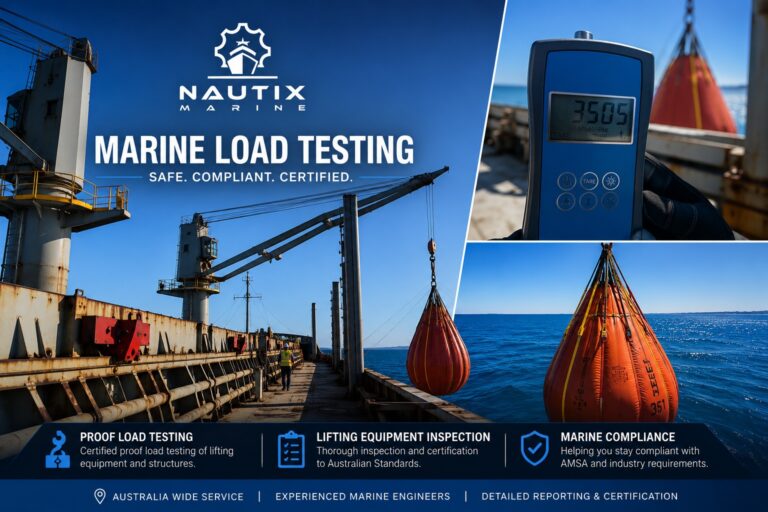
Marine Load Testing Services
At Nautix Marine Solutions, we provide professional marine load testing services throughout Australia, supporting vessel owners, ship managers, ports, offshore operators and marine contractors. Our experienced inspectors and engineers conduct proof load testing, lifting equipment inspections and certification services to verify the safety, integrity and operational readiness of critical lifting assets.
Using calibrated load cells, certified water weights and industry-approved testing procedures, we perform marine crane load testing, accommodation ladder testing, gangway testing, davit testing and lifting appliance verification in accordance with applicable Australian and international standards. Each project is supported by detailed reporting and certification to assist vessel operators in meeting regulatory and operational requirements.
Whether validating a newly installed crane, conducting periodic proof load testing, or preparing for an AMSA, Class or client inspection, Nautix Marine Solutions delivers safe, efficient and compliant testing services with minimal disruption to vessel operations. Our Australia-wide capability allows us to mobilise quickly to ports, shipyards and offshore facilities to support planned maintenance, audits and critical operational requirements.
Our Marine Load Testing Capabilities
- Marine Crane Load Testing
- Proof Load Testing of Lifting Appliances
- Accommodation Ladder Load Testing
- Gangway Load Testing
- Lifeboat Davit Load Testing
- Water Weight Load Testing
- Lifting Beam and Spreader Bar Testing
- Load Cell Measurement and Verification
- Lifting Equipment Inspection and Certification
- AMSA and Marine Compliance Support
Our certified technicians are committed to delivering services that minimize downtime and enhance operational safety. Whether for routine maintenance or post-repair validation, trust Nautix Marine Solutions to keep your lifting operations compliant and efficient.
A crane that lifts reliably at berth can still become a liability offshore if its true capacity, structural condition or safety systems have not been verified under test. That is why marine crane load testing is not just a box-ticking exercise. It is a controlled, evidence-based process that confirms the crane can operate within its rated limits, supports compliance, and reduces the risk of failure when the vessel is under commercial pressure.
For vessel owners, ship managers and offshore operators, the issue is rarely whether testing matters. The real question is whether it has been planned and executed properly, with the right method, the right certification pathway and a clear understanding of the crane’s service history. Done well, load testing gives confidence before AMSA attendance, class surveys, charter mobilisation and high-risk lifting campaigns. Done poorly, it creates delays, exposes defects at the worst possible time and can leave questions around the validity of the result.
What marine crane load testing actually proves
Marine crane load testing verifies that a crane can safely handle a specified proof load under controlled conditions. That sounds straightforward, but the result is only meaningful when it is tied to a full inspection scope. The load test itself demonstrates performance under load. It does not, on its own, prove that every component is in acceptable condition or that maintenance obligations have been met.
In practice, the test sits alongside structural checks, wire rope assessment, brake verification, limit switch function, sheave and hook examination, hydraulic or mechanical system review, and confirmation that certification records align with the crane’s current configuration. For that reason, a proper testing programme is never just about hanging a weight and recording a pass.
This matters particularly on commercial vessels and offshore assets where cranes are exposed to corrosion, dynamic loading, heavy utilisation and maintenance gaps between ports. A crane may appear operational in day-to-day use while still carrying hidden risk in the boom structure, slew ring, winch arrangement or wire condition. Load testing provides one of the clearest opportunities to identify that risk before it turns into downtime or an incident.
When marine crane load testing is required
Testing intervals and triggers depend on the crane type, its flag and class requirements, operating profile, and whether major repairs or alterations have taken place. There is no single rule that applies to every vessel in every operating context. That said, several situations commonly trigger the need for testing.
A newly installed crane will require proof load testing before being placed into service. A crane that has undergone substantial repair, structural modification, wire renewal, winch overhaul or other major maintenance may also require retesting. Periodic surveys can call for testing as part of statutory or class verification. Operators often arrange testing ahead of AMSA inspections, after defect notices, before offshore mobilisation, or when taking over a vessel with incomplete lifting records.
The commercial reality is that timing matters just as much as compliance. If a crane is due for load testing, leaving it until just before sailing can create avoidable pressure. Weather, access, certified test weights, supporting equipment and surveyor availability all affect delivery. A well-planned attendance reduces the chance of schedule impact and gives space for rectification if a defect is found.
Why inspection history changes the testing approach
Two cranes with the same safe working load may require very different test plans. One may be well maintained, fully documented and only due for routine periodic verification. The other may have uncertain records, visible corrosion, overdue wire replacement or signs of brake performance issues. In the first case, testing can often proceed efficiently with standard preparation. In the second, pre-test inspection may identify defects that should be corrected before proof loading begins.
That distinction is important. Forcing a crane into a load test without resolving known issues can increase risk and produce a result that does not stand up to scrutiny. The safest and most efficient path is usually to inspect first, test second, then certify with complete records.
How the load testing process should be managed
A credible marine crane load testing programme starts with document review. The service team needs to confirm crane particulars, rated capacity, previous certificates, maintenance records and the applicable survey or compliance framework. From there, the physical condition of the crane is assessed so the testing method matches the equipment and site conditions.
The next stage is test planning. This includes selecting the proof load, confirming the lifting radius or operational envelope to be tested, arranging calibrated test weights or approved alternatives, and identifying any vessel stability or deck loading considerations. On board, the work area must be controlled properly, with clear exclusion zones, communications and lifting supervision. Offshore and marine environments add complexity because deck movement, access limitations and operational constraints can influence how the test is performed.
During the test, the crane is loaded in accordance with the relevant procedure and observed for structural behaviour, brake holding, control response and general operating performance. Safety devices and limit functions are typically checked as part of the broader attendance. Once testing is complete, the findings must be documented clearly, including any defects, restrictions, repairs required and the certification outcome.
For commercial operators, the paperwork matters nearly as much as the physical test. If certificates, reports and traceable test records are incomplete, the operational value of the attendance drops quickly. Surveyors, auditors and clients need clear evidence that the work was performed competently and that the crane is fit for continued service within its approved limits.
Common issues found during marine crane load testing
Load testing often exposes problems that routine operation has masked. Brake slippage is one of the most common concerns, particularly on cranes that have seen heavy use or inconsistent maintenance. Wire rope deterioration is another, especially where corrosion, poor spooling or age-related wear has not been addressed in time.
Structural cracking, localised deformation, worn sheaves, hydraulic leaks, limit switch faults and hook assembly defects also appear regularly during pre-test inspection or under load. In some cases, the crane itself is mechanically sound but the records are not. Missing certificates, unclear safe working load markings, absent maintenance history or undocumented modifications can still prevent a clean compliance outcome.
There is also a practical trade-off between speed and assurance. Some operators want the shortest possible attendance to keep the vessel moving. That is understandable, but compressed testing without proper inspection or documentation can create greater delay if a surveyor rejects the result or a defect forces a repeat attendance. A competent provider will keep the programme efficient without cutting the steps that protect compliance and safety.
Choosing a service partner for marine crane load testing
For safety-critical lifting equipment, technical capability is only part of the requirement. The provider also needs a working knowledge of marine operations, vessel constraints and Australian compliance expectations. That includes understanding how to coordinate testing around port schedules, class attendance, AMSA readiness and offshore mobilisation windows.
Operators should look for a team that can manage the full scope – inspection, wire assessment or renewal where required, proof load testing, defect identification, rectification support and certification. That end-to-end approach reduces handover risk and shortens the path from finding a defect to clearing it. It also gives vessel managers a clearer line of accountability.
In the Australian market, practical responsiveness matters. A technically correct plan has limited value if it cannot be delivered when the vessel is available. Nautix Marine supports commercial and offshore operators with crane inspection, wire renewal and load testing services designed around real vessel schedules, compliance deadlines and operational risk.
The value goes beyond compliance
The immediate purpose of load testing is to verify safe lifting performance, but the wider operational value is just as significant. A tested and properly certified crane reduces the likelihood of lifting interruptions, protects crews working around suspended loads and gives managers stronger assurance when planning cargo handling, stores transfer or offshore support tasks.
It also sharpens maintenance decisions. When testing is combined with thorough inspection, operators get a clearer picture of which components need immediate attention and which can be managed through planned maintenance. That supports budget control without relying on guesswork or running equipment to failure.
For vessels trading under tight schedules, that clarity is commercially useful. Fewer surprises at survey, fewer last-minute defects and fewer disputed records mean less disruption to charter commitments and port operations. In high-accountability sectors such as offshore support and oil and gas, that reliability is not optional. It is part of staying operational.
A marine crane should never be assumed safe simply because it worked yesterday. The test only has value when it is properly planned, competently executed and backed by documentation that stands up under scrutiny. If your lifting equipment is due for verification, approaching the job early and with the right technical support usually saves far more than it costs.


GET A LOAD TESTING QUOTE
Need Marine Load Testing?
✔ Ship Cranes
✔ Gangways
✔ Accommodation Ladders
✔ Davits
✔ Lifting Equipment
Need Help? Talk to Nautix Marine