
A marine risk assessment is a structured way of finding what could go wrong in a vessel’s operation, judging how likely and how serious each outcome is, and deciding what controls bring the risk to an acceptable level. For commercial vessels in Australia it is the foundation of the safety management system, and it should be repeated whenever the task, the equipment or the conditions change. This guide sets out what to identify, how to rate it, which controls to prefer, and how the assessment connects to inspections, load testing and AMSA compliance.
TL;DR
- A marine risk assessment identifies hazards, rates each by likelihood and consequence, applies controls and then monitors whether those controls work.
- AMSA describes the risk assessment as the foundation of a safety management system, covering daily tasks, emergencies and risks to vessel operations.
- Controls are ranked by effectiveness: eliminate or substitute the hazard first, and treat PPE as the last resort.
- Inspection and testing records feed the assessment, and the assessment tells you which equipment needs inspection first.
- If a risk stays too high after extra controls, the operation should go back to shoreside management or not proceed.
Table of Contents
- What a marine risk assessment is and when to carry one out
- Which hazards a marine risk assessment should identify
- How hazards are rated and risk levels decided
- Choosing controls that actually reduce the risk
- Records, monitoring and review
- How risk assessment supports inspections, maintenance and compliance
- A worked example: assessing a crane lift
- Our perspective: verified equipment is the strongest control
- Turning your assessment into inspections and tests
- Common mistakes to avoid
- FAQ
- Sources
What a marine risk assessment is and when to carry one out
A risk assessment answers four plain questions. What can go wrong? How likely is it? How bad would it be? What are we doing about it? The vocabulary is consistent across the guidance used by the industry: a hazard is the source of potential harm, a risk scenario is how that hazard could lead to an incident, the consequence is the outcome, and a control is anything that reduces the likelihood or the consequence, as defined in the Washington State Department of Ecology guidance on vessel operations risk assessment.
In Australia the legal anchor for domestic commercial vessels is the safety management system. AMSA’s guidelines state that owners and operators of a domestic commercial vessel are required by law to implement and maintain an SMS, and that the SMS may be assessed by AMSA at any time. Risk assessment sits within the Vessel and Operation part of that system, alongside contact details and maintenance of the vessel and equipment.
That tells you when to carry one out. In practice, the triggers are:
- Before a vessel enters service or starts a new type of operation, such as a change of trade, a new charter or a new port.
- Before a non-routine task, such as heavy lifting, a proof load test, work aloft, or work on a mooring winch brake.
- After an incident, near miss or non-conformance, when the controls in place clearly did not do what was expected.
- After modifications or equipment changes, including replaced wire rope, a new crane, or revised emergency equipment.
- At planned review intervals, so the assessment stays current with how the vessel actually operates.
Seafarers sometimes treat the assessment as paperwork completed once for an audit. The better practice is to treat it as a working document that crew can read before a job and that a superintendent can use to decide where maintenance effort goes.
Which hazards a marine risk assessment should identify
AMSA’s guidelines describe the risk assessment as the process that identifies the key daily tasks, the emergency situations and the risks to vessel operations that must be managed, and it includes when a lifejacket must be worn. That gives three useful lenses: routine tasks, emergencies, and the equipment or conditions that cause trouble in both.
Steamship Mutual’s guidance on risk assessment calls hazard identification probably the most difficult step, and recommends basing it on observing the activity under realistic conditions rather than working from a desk. The practical lesson is to walk the job with the people who do it.
The table below lists hazard areas that inspection and operational assessments commonly cover on commercial vessels, with the question to ask for each. It is a working prompt list, not a regulatory schedule.
| Hazard area | Typical scenario | Question to ask |
|---|---|---|
| Lifting appliances (cranes, davits, derricks) | Wire failure or overload during cargo or stores handling | When was the last load test, and what condition are the wires and brakes in? |
| Wire ropes | Broken wires, corrosion or internal damage not visible on the surface | Has the rope been inspected to a documented method, and is a replacement trigger defined? |
| Mooring equipment | Winch brake slipping, line parting under load | Has the brake holding capacity been verified, and are the lines within their service life? |
| Access equipment | Gangway or accommodation ladder failure, slips and falls | Is the equipment tested and certified, and is the rigging checked before each use? |
| Life-saving appliances | Lifejackets, liferafts or lifeboat gear fail when needed | Are the items serviced on schedule and are crew trained to use them? |
| Fire-fighting appliances | Extinguishers, fixed systems or fire pumps not ready | Are inspection and servicing records current and are faults rectified? |
| Navigation and collision | Equipment failure, poor visibility, restricted waters | What detects or prevents collision, and is it treated as safety critical? |
| Weather and sea state | Operating outside the safe envelope | Who decides to stop, and on what criteria? |
| Inspection activity itself | Working at height, enclosed spaces, hot work, suspended loads | Who is exposed during testing, and how is the area controlled? |
The last row matters. The inspection safety risks the keyword hints at are real: load testing involves suspended weights, rope inspection often involves access aloft, and brake tests involve moving machinery under load. A competent inspection provider writes its own task risk assessment and shares it with the vessel before work begins, so the ship’s crew and the inspection team control the same hazards.
How hazards are rated and risk levels decided
There is no single mandated method, but the main published frameworks agree on the sequence. ABS guidance notes on risk assessment for marine and offshore applications describe four steps:
- Risk identification. Identify possible sources of hazardous events, their causes, their potential consequences and the safeguards already in place.
- Risk analysis. Estimate frequency and consequence, and analyse how effective the existing safeguards are.
- Risk evaluation. Compare the results against risk acceptance criteria.
- Risk treatment. Select options to modify the risk, implement them and check that the residual risk is tolerable.
The same guidance notes that choosing the right analysis technique, or combination of techniques, is key to a successful analysis, with techniques commonly summarised by reference to ISO 31010. For most vessel tasks a simple qualitative matrix is enough. Formal techniques suit major changes or high-consequence systems.
Using a likelihood and consequence matrix
The Department of Ecology guidance describes judging likelihood from the hazard, the risk scenario and the controls already in place, using example levels of certain, likely, possible, unlikely and rare. That likelihood is then combined with the consequence on a risk rating matrix to produce a rating. Each company sets its own thresholds for what is acceptable.
Two habits keep the matrix honest:
- Rate with the controls in place, then rate again after adding new ones. The gap between the two is the evidence that a control is worth having.
- Score the realistic worst credible outcome, not the most comfortable one. A wire rope that parts during a lift can injure or kill, so a low probability does not make the consequence minor.
Choosing controls that actually reduce the risk
Once the rating is above your threshold, controls are selected. Steamship Mutual sets out a hierarchy from most to least effective:
- Elimination
- Substitution
- Enclosure
- Guarding or segregation
- Safe system of work
- Written procedures
- Review of the blend of technical and procedural controls
- Adequate supervision
- Identification of training needs
- Information and instruction
- Personal protective equipment, as the last resort
The order is the point. Replacing a worn wire rope removes the hazard of its failure, which beats a procedure that asks crew to stand clear of the lift. A procedure beats a reminder, and a reminder beats PPE. Many vessel risk assessments lean on the bottom of the list because it is cheapest on paper, which is why verified equipment condition, through inspection and testing, is such a strong control.
When the rating stays too high
The Department of Ecology guidance gives a clear decision path. If the rating exceeds company thresholds, apply additional controls and repeat the assessment to obtain a revised rating. If the risk remains too high even then, review the operation with shoreside management or decide not to conduct it. Write that path into the procedure so that a master or chief engineer has explicit authority to stop, with no commercial pressure to argue against.
Records, monitoring and review
A control that is selected but never checked is only an assumption. Steamship Mutual’s fourth activity is performance monitoring: confirming that controls are used correctly and that they have really reduced the risk. A usable record includes:
- The task or scenario assessed, the date and who took part.
- The hazards identified and the existing controls.
- The initial rating, the additional controls and the revised rating.
- The person responsible for each control and the date it should be in place.
- The review date and the trigger events that bring the review forward.
Maintenance records belong in the same picture. AMSA’s SMS guidelines require maintenance documentation that includes records of regular planned inspection periods and maintenance activities appropriate for the vessel, its machinery and its equipment, including safety equipment. These can be kept in log books or other systems, including computerised planned maintenance. When an inspection or test report is filed against the equipment it covers, the next risk review starts from facts, not recollection.
How risk assessment supports inspections, maintenance and compliance
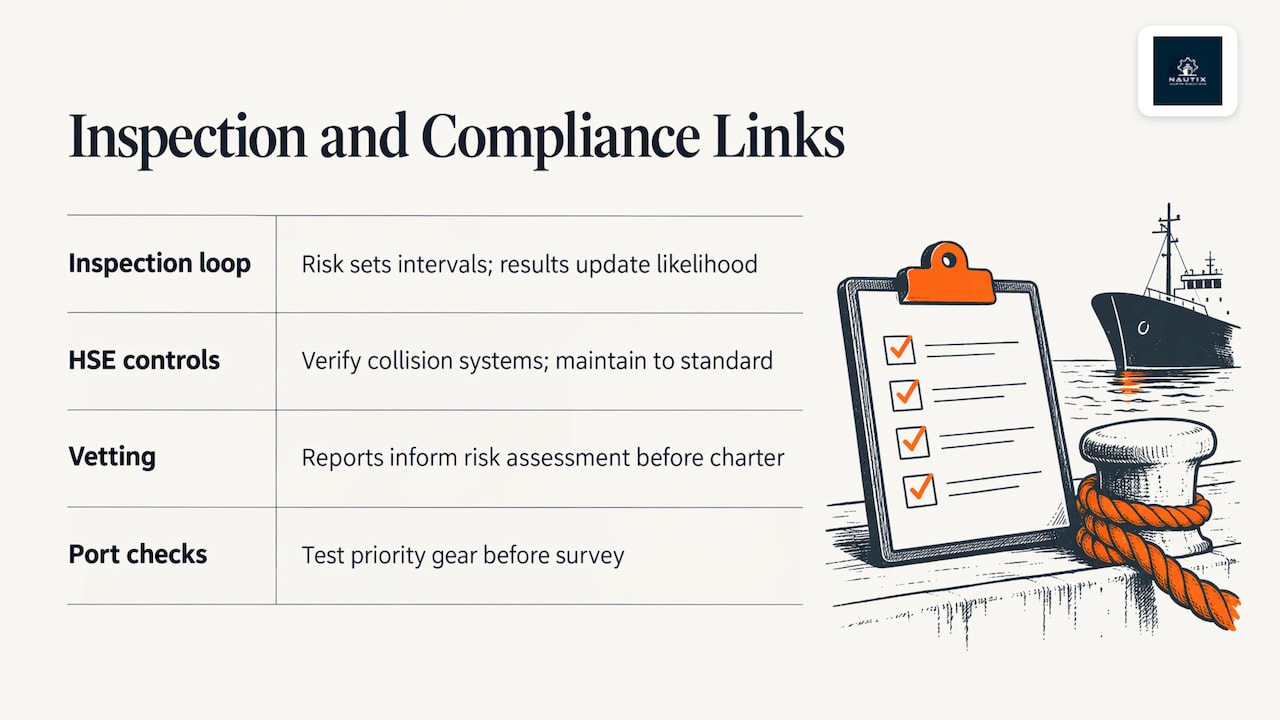
Risk assessment and inspection feed each other. The assessment says which equipment failures would hurt most, so those items get the tightest inspection intervals. The inspection results then update the likelihood side of the matrix.
The same logic shows up in other regimes. The UK Health and Safety Executive’s offshore marine operations inspection guide expects dutyholders to have collision risk management arrangements, to treat the equipment that detects or prevents collision as safety critical, and to verify its performance and keep it maintained to the required standard. It also expects vessels working near an installation to follow dutyholder procedures and to operate only in suitable weather. These are risk assessment outputs turned into controls and checks.
In commercial shipping, vetting works the same way. OCIMF’s OVID inspection database description says inspection reports contribute to a member company’s risk assessment before charter and can be accessed by registered companies for vessel assurance. A clean, well-documented inspection history is therefore part of how a vessel is judged before it is fixed.
For vessels calling at Australian ports, the practical connection is Port State Control. A risk assessment that flags lifting gear, life-saving appliances, fire-fighting equipment and mooring arrangements as priority items will usually point at the same areas where deficiencies are found. A pre-AMSA inspection is a way of testing that assessment against the condition of the ship before the surveyor arrives, and AMSA defect rectification closes the loop when something is found.
A worked example: assessing a crane lift
Take a ship’s crane used for stores and for lowering a heavy item to a barge alongside. The assessment might run as follows.
Hazards identified. Wire rope failure, brake failure, overload, swing of the load, dropped object, and personnel under the load. Weather and swell alongside add movement.
Existing controls. Annual crane inspection, a safe working load plate, a lifting procedure and a banksman.
Initial rating. The likelihood of wire or brake failure is judged possible, because the last wire inspection was on paper only and the wire has a few years of service. The consequence is severe. The rating exceeds the company threshold.
Additional controls. A documented wire rope inspection, replacement of wire if it is outside its criteria, and a load test of the crane to verify the rated capacity and the brake. The exclusion zone under the load is marked and enforced, and the lift is stopped above an agreed swell limit.
Revised rating. With the wire condition and the brake verified, likelihood falls to unlikely, and the revised rating sits within the threshold. The lift can proceed under the safe system of work.
Monitoring. The supervisor confirms the exclusion zone is in use, the test report is filed against the crane, and the next wire inspection date is entered in the planned maintenance system.
The example shows why verification matters: it moves a control from an assumption to a documented fact. Our pages on crane wire rope inspection and marine load test certification explain what those records contain.
Our perspective: verified equipment is the strongest control
We work with ship owners, technical superintendents and vessel operators at Australian ports, and the pattern we see is consistent: the risk assessment is usually sound, and the weak point is the evidence behind the controls.
A procedure that says the crane is safe to lift is only as good as the last time someone proved it. That is why we treat load testing as more than a box-ticking exercise. Marine crane load testing, waterbag load testing for capacities up to 270 tonnes, wire rope Magnetic Rope Testing for ropes up to 70mm diameter and mooring winch brake rendering tests all turn an assumption in your risk matrix into a documented result.
Built by seafarers for seafarers, our approach is practical. We plan the work with the vessel, agree the controls for the test itself, and deliver inspection documentation and detailed test reports that you can file against the equipment and show to a surveyor.
If your assessment lists lifting gear, mooring equipment, life-saving appliances or fire-fighting appliances as priority items, an inspection and test programme is the most direct way to reduce the rating, and it also supports your compliance position with AMSA and international requirements.
the author
Turning your assessment into inspections and tests
Once your matrix shows where the highest ratings sit, we can help you act on them. Nautix Marine Solutions provides marine crane load testing, lifting appliance inspections, wire rope MRT, mooring winch brake rendering tests, FFA and LSA inspection and servicing, pre-AMSA inspections and AMSA defect rectification at Australian ports, with test reports and inspection documentation for your records.
Start with the service that matches your highest-rated hazard: marine load testing for cranes and lifting gear, mooring winch brake rendering tests for mooring equipment, or FFA and LSA inspection and servicing for emergency equipment. Contact us through nautixmarine.com.au to plan the work around your port call.
Common mistakes to avoid
- Assessing from the office. Hazards are missed when nobody has watched the job done under realistic conditions.
- Copying a generic template. AMSA’s guidelines expect the assessment to reflect your vessel and operation, so adapt every template to the vessel’s own tasks and equipment.
- Stopping at the rating. A number with no named control, owner and date does not reduce anything.
- Leaning on PPE. It is the last control in the hierarchy, not the first.
- Never revisiting it. Review after incidents, modifications and test findings, not only on the calendar.
- Separating inspection records from the assessment. Test reports and defect closures should be referenced in the next review.
FAQ
Is a marine risk assessment a legal requirement in Australia?
For domestic commercial vessels, owners and operators must implement and maintain a safety management system, and AMSA’s guidelines place the risk assessment inside that system. AMSA may assess the SMS at any time. Check AMSA’s current guidance for your vessel class and operation.
How often should a marine risk assessment be reviewed?
Review it at the interval set in your safety management system, and sooner after an incident, near miss, modification, change of operation or new inspection findings. The aim is that the assessment always reflects how the vessel is actually operated and the condition of its equipment.
What is the difference between a hazard and a risk?
A hazard is the source of potential harm, such as a worn wire rope under load. The risk is the combination of how likely the harm is and how severe the consequence would be, given the controls already in place. Rating risk, not just listing hazards, is what lets you prioritise.
Who should take part in the assessment?
Include the people who do the task, the person responsible for the equipment, and a supervisor or superintendent with authority to approve controls. Observing the activity in realistic conditions gives better hazard identification than a desk exercise.
How do inspections and load tests reduce risk ratings?
They replace assumptions about equipment condition with documented results. When a crane, wire rope or winch brake is verified, the likelihood of its failure can be rated on evidence, which supports a lower revised rating and a clearer record for AMSA or charterer vetting.
Sources
- AMSA, Guidelines for a Safety Management System (October 2023)
- Washington State Department of Ecology, Risk Assessments for Vessel Operations
- ABS, Guidance Notes on Risk Assessment Applications for the Marine and Offshore Oil and Gas Industries (May 2020)
- Steamship Mutual, Guidance for Risk Assessment (May 2014)
- HSE, The Offshore Marine Operations Inspection Guide
- OCIMF, OVID Inspection Database