
A crane wire rope inspection is a structured examination of the entire rope length, from the end terminations to the sections that run over sheaves and spool on the drum, and it ends with a decision: keep in service, monitor, or replace. Operators check the rope every shift, a competent person inspects it at set intervals, and a qualified person carries out a full inspection at least annually. Where hidden internal damage is a concern, Magnetic Rope Testing (MRT) is added to the visual examination.
This guide sets out what each level of inspection involves, which defects matter, how MRT fits in, and when a rope has to come out of service. It is written for ship owners, technical superintendents and fleet managers who manage cranes and lifting appliances at Australian ports.
TL;DR
- Inspection works in layers: a visual check before each shift, more detailed periodic examinations, and a thorough annual inspection by a qualified person covering the full rope length.
- Inspectors look for broken wires, wear and reduced diameter, corrosion, deformation, heat damage, elongation and defective end connections, then judge the combined effect.
- MRT detects internal and external damage that a visual check alone can miss, and international guidance says it should accompany a visual inspection.
- A rope with a safety-critical defect stays out of service until it is replaced. Splicing lengths together is not an acceptable fix.
- Rope condition assessment and crane load testing answer different questions, and many vessels schedule them together.
Table of Contents
- What a crane wire rope inspection involves
- How often a crane wire rope should be inspected
- What inspectors look for
- Visual inspection and magnetic rope testing
- When a rope must be removed from service
- Rope inspection and crane load testing are different checks
- When to bring in a specialist rope assessment
- Perspective
- How Nautix supports crane rope work
- FAQ
- Sources
What a crane wire rope inspection involves
The NSW Government guide to wire rope inspections describes the starting point well: identify where deterioration is most likely to occur, then run the whole rope and record breaks, surface wear and diameter, corrosion and elongation. On a ship’s deck crane, those high-risk zones are predictable:
- the ends of the rope, both the fixed termination and the winding end
- sections that run under load over sheaves and pulley blocks
- sections that wind over compensating sheaves
- abrasion-contact points
- sections exposed to corrosion and fatigue
The list of zones to examine closely comes from PRS Informative Publication No. 10/I, which covers wire ropes for lifting appliances. Marine cranes add a further factor: salt, spray and washdown accelerate corrosion, and ropes that sit idle between cargo operations can deteriorate internally while looking acceptable on the outside.
A competent inspection also takes in the rope’s surroundings: drum flanges, crossover points where layers cross on a multi-layer drum, sheave grooves, and the condition of end fittings. ISO 4309 notes that deterioration is significantly greater at crossover zones on the drum than elsewhere on multi-layer spooling ropes, so these are examined with extra care.
Visual and hands-on checks
The familiar field method is the rag-and-visual check. CCOHS describes it: the inspector lightly grips the moving rope with a cloth, and broken wires often catch on the rag. The same source adds that some wire breaks may not catch, which is one reason visual checks are supported by closer examination and, where appropriate, by instrument testing.
How often a crane wire rope should be inspected
There is no single rule for every vessel. The frequency depends on the flag, class society, the crane’s duty and the rules that apply to the job. A few reference points show the common pattern.
The US OSHA fact sheet on wire rope inspection sets out a shift inspection before each shift, a monthly inspection and an annual inspection at least every 12 months. Shift inspections are visual and do not require opening up the rope. The annual inspection is by a qualified person and covers the entire rope length.
The NSW guide to dogging and rigging takes a similar approach: ropes are inspected daily by the operator, at regular intervals by qualified personnel, and when recommissioning machinery. CCOHS recommends keeping records of daily inspections and thoroughly inspecting any rope that has not been used for a month before it goes back to work.
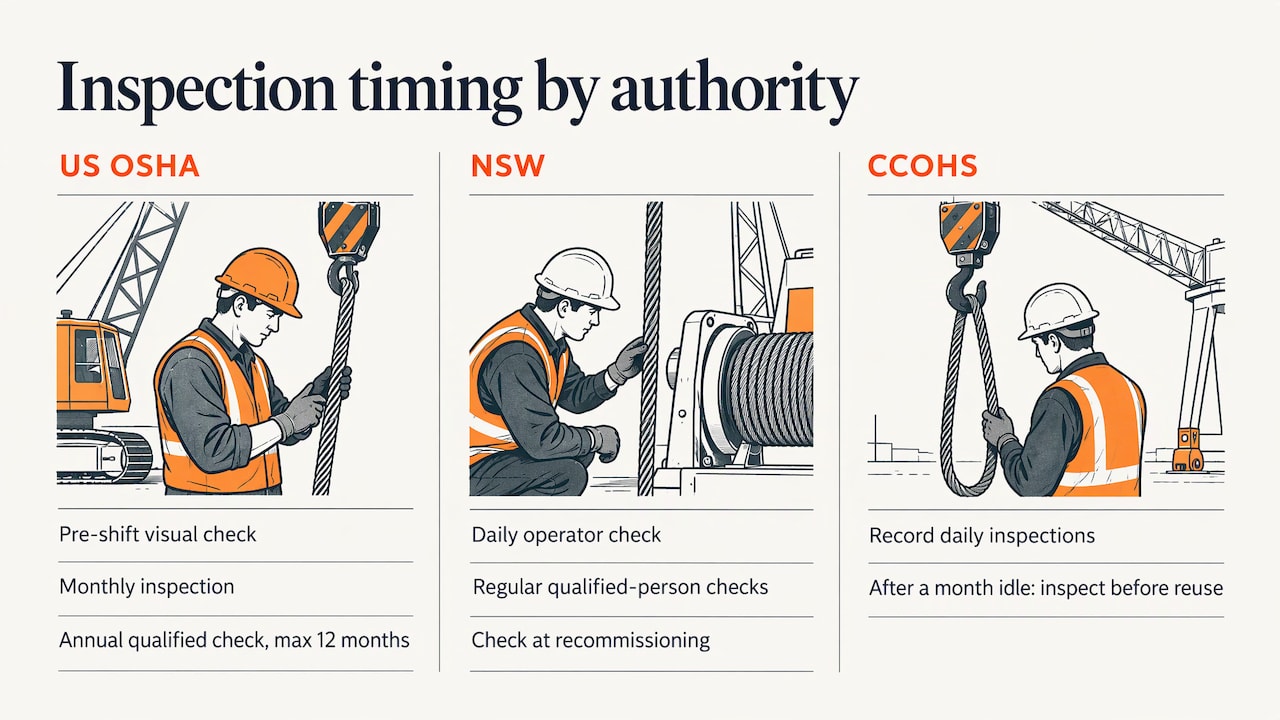
These are the United States, New South Wales and Canada respectively, not a single Australian maritime rule. For a vessel at an Australian port, confirm the interval that applies with your class society, flag administration and planned maintenance system, and make sure the paperwork matches what the crew actually does.
The three tiers in practice
| Level | Who | What | Record |
|---|---|---|---|
| Pre-use or shift check | Operator or competent person | Visual check of accessible rope, terminations and sheave areas | Log entry |
| Periodic inspection | Competent person | Closer examination, measurement of diameter, check of known high-wear zones | Written record |
| Annual or comprehensive inspection | Qualified person, with MRT where appropriate | Full-length examination, measurement, assessment against discard criteria | Report with findings and decision |
The OSHA fact sheet also requires documentation of monthly and annual inspections. Whichever rule applies to you, a dated, signed record is what a surveyor or port state control officer will ask to see.
What inspectors look for
Broken wires are the defect most people think of, but they are only one of several. ISO 4309:2017 requires examinations to consider the nature and number of broken wires, strand fracture, diameter reduction including core deterioration, wear, corrosion, deformation, heat or electric arc damage and the rate of increase of permanent elongation. OSHA’s rule likewise ties removal from service to structural distortion, corrosion, heat damage, end-connection defects and diameter reduction, not only to wire counts.
In practice, the findings that matter on a vessel crane are:
- Broken wires, counted over a defined rope length and noted where they cluster in one strand or at a termination.
- Reduced diameter, which can signal core deterioration or internal wear even when the outside looks sound.
- Corrosion, external pitting or internal corrosion that stiffens the rope and weakens individual wires.
- Deformation: kinking, crushing, birdcaging, unstranding, or a core protruding between outer strands.
- Heat or arc damage, for example from welding near the rope.
- Permanent elongation, which can show that the rope is losing its structure.
- End connection defects: corroded, cracked, bent or worn fittings, or fittings applied incorrectly.
The key idea in ISO 4309:2017 is that deterioration is not judged mode by mode alone. The standard describes assessing severity as a percentage of individual discard criteria, or in words from slight through to discard, and it gives a method for assessing the combined effect of damage at any position in the rope. A rope with moderate wear, moderate corrosion and a few broken wires can warrant replacement even if no single figure has reached its limit.
Visual inspection and magnetic rope testing
Visual inspection sees the surface. Internal broken wires, corrosion under the outer strands and loss of metallic area are not visible from outside, particularly on larger-diameter or rotation-resistant ropes.
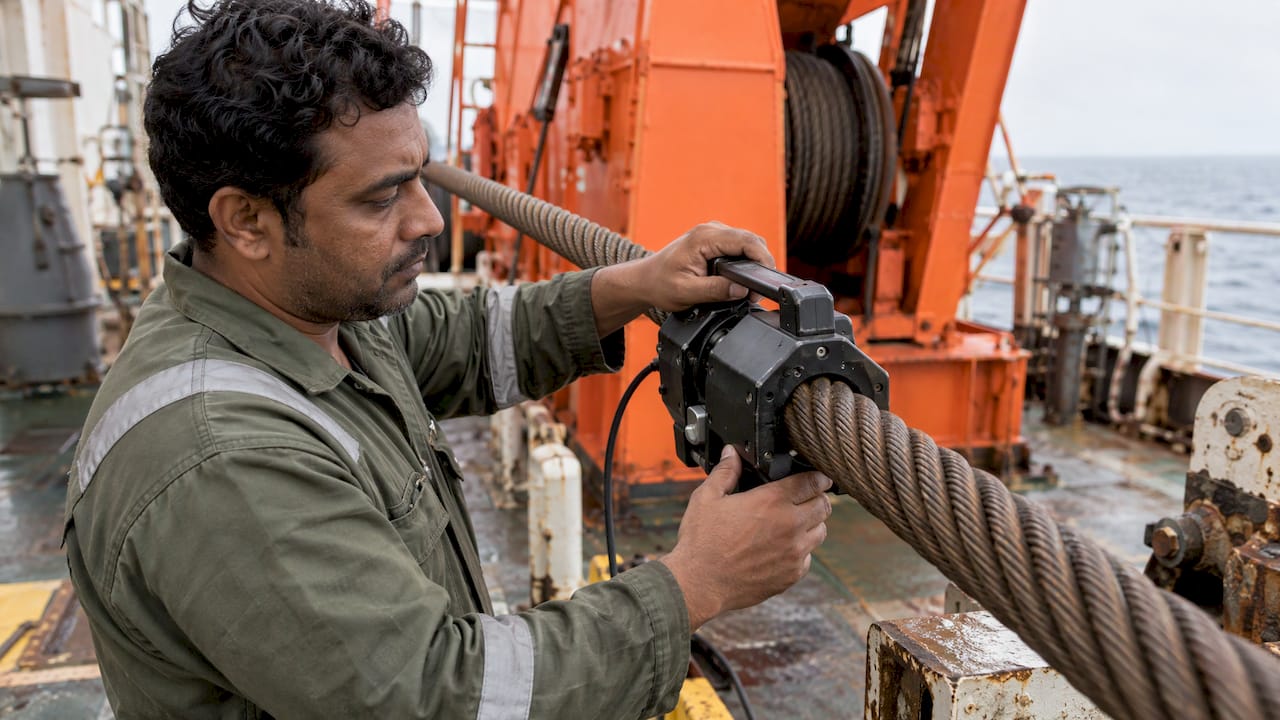
MRT magnetises the rope and measures the magnetic field along its length. According to the PRS publication, the rope is magnetised to full saturation and tested at speeds up to 4 m/s, and damage inside the rope disturbs the field, which allows early detection of internal and external broken wires, corrosion, clamping points, grooves and structural changes. Results can be visualised, documented and analysed.
Two points from ISO 4309:2017 shape how MRT should be used:
- MRT should be used where defects might exist that visual inspection alone would not identify, and should be performed together with a visual inspection.
- It is beneficial to record an MRT base trace before installation or soon after, so later traces have something to be compared against.
For offshore and marine work, IMCA publishes a recommended practice for MRT examination of steel wire rope, including data interpretation and rejection criteria, and a separate recommended practice on wire rope integrity management for vessels covering selection, storage, handling, maintenance, inspection and discard.
The practical conclusion: MRT and visual examination are partners. The instrument trace shows where to look, and the inspector’s eyes and calipers confirm what is there.
When a rope must be removed from service
The decision to replace is the point of the inspection. Different documents give different numbers, so use the criteria that apply to your crane, and treat these as examples of how discard rules are written.
CCOHS gives specific figures for hoist ropes: 6 or more broken wires in one rope lay length for running ropes, or 3 or more in one strand in one lay, and 3 or more in one lay length for standing ropes. It also lists one-third wear of the original diameter of outer wires, and kinking, crushing, cutting, unstranding or birdcaging, as grounds for discard.
OSHA’s removal-from-service criteria include significant distortion, significant corrosion, heat or arc damage and improperly applied or damaged end connections. Its rule also covers what happens next: operations stop until the rope is replaced or, where the deficiency is localised, corrected by severing the rope in two, with splicing of lengths prohibited.
PRS puts the principle plainly: a rope on a lifting appliance is a wearing element and should be replaced when further use would be unwise from a safety standpoint.
What a proper replacement involves
- Confirm the replacement rope’s construction, diameter and grade against the crane manufacturer’s specification.
- Check the drum, sheaves and fleet angles, because a worn groove will damage a new rope quickly.
- Fit terminations correctly and inspect them.
- Record the rope’s certificate and, where used, an MRT base trace.
- Return the crane to service with the documentation updated.
For marine cranes, ISO 19360:2016 sets minimum technical requirements for the selection and application of running and standing rigging, including criteria for installation, maintenance, inspection and discard.
Rope inspection and crane load testing are different checks
They are often booked together, but they answer different questions. A rope inspection or MRT assessment tells you the physical condition of the rope. A marine load test confirms that the crane, its structure, brakes and rope perform at the rated load, and it ends in a certificate. Load test certification is the document class, flag and port authorities look for.
For cranes where testing is done with test weights that suit the vessel and berth, water bag load testing allows a controlled test without bringing heavy fixed weights onboard. A sensible sequence is to inspect and, if needed, renew the rope first, then load test, so the test is carried out on a rope you have already assessed.
When to bring in a specialist rope assessment
CCOHS advises that only trained personnel should inspect wire rope. Beyond that baseline, a specialist assessment makes sense when:
- the annual inspection is due and the rope has a long service history
- the vessel works in a corrosive or heavy-duty environment such as bulk loading or offshore support
- the rope is a large diameter or rotation-resistant type where internal damage is hard to see
- a new rope has just been fitted and you want a baseline trace
- a crane is being recommissioned after lay-up or repair
- you are preparing for a flag, class or AMSA inspection and want rope records in order
If the crane is part of a wider pre-inspection plan, our pre-AMSA inspection service looks at the vessel as a whole, and any defects found can be handled through AMSA defect rectification.
Perspective
Wire rope is the part of a crane that quietly wears out while everything else looks fine. We see the same pattern on vessels at Australian ports: the structure and the machinery get attention, while the rope is checked by eye and signed off.
Our view is that the inspection record should show a decision, not just an observation. That means measured diameter, located defects, a stated assessment against the discard criteria, and a clear instruction: continue, monitor or replace. When a rope is suspect, MRT gives the inspector a trace of the whole length, so the examination is focused on the places that need it.
We built Nautix on seafarers’ experience. We know that a vessel’s schedule at berth is short, and that a rope found defective on the day of a cargo operation is a costly surprise. Doing the assessment early, with the replacement and load test planned in the same visit, keeps the crane working and the paperwork complete.
the author
How Nautix supports crane rope work
Nautix Marine Solutions carries out wire rope MRT for ropes up to 70 mm in diameter, and our crane service covers inspection, wire renewal and load testing in a single engagement, supported by detailed inspection documentation and test reports. We work across Australian ports.

To plan an inspection, a rope renewal or a load test, see our crane inspection, wire renewal and load testing page or get in touch through our main site.
FAQ
How often should a crane wire rope be inspected?
The operator checks it before each shift, and a qualified person inspects the full rope length at least every 12 months under the OSHA rule. Monthly or periodic examinations sit in between. Confirm the interval your class society and flag require for the vessel.
Can a crane wire rope be repaired?
A localised deficiency may be corrected by cutting out the damaged section, but OSHA prohibits splicing lengths together, and a shortened rope must keep two wraps on the drum at the lowest load or boom position. Many defects mean full replacement, so the inspection record should state the decision.
What does MRT show that a visual inspection does not?
MRT measures the magnetic field along the rope and identifies internal broken wires, internal corrosion and structural changes that cannot be seen from outside. ISO 4309:2017 says it should be used together with a visual inspection, not in place of one.
Is a wire rope inspection the same as a crane load test?
No. The inspection assesses the rope’s condition. The load test confirms the crane’s performance at its rated load and results in a certificate. Both are commonly scheduled together.
Sources
- NSW Government: Dogging and Rigging guide, wire rope inspections
- PRS Informative Publication No. 10/I, Wire Ropes for Lifting Appliances
- ISO 4309:2017, Cranes: Wire ropes, care and maintenance
- CCOHS: Materials Handling, Hoist Wire Rope
- OSHA FactSheet 3635, Wire rope inspection
- ISO 4309 (2004 edition) on deterioration modes
- OSHA 1926.1413, Wire rope inspection
- ISO 4309:2017 full text
- IMCA recommended practice for MRT examination of steel wire rope
- IMCA recommended practice on wire rope integrity management
- ISO 19360:2016, Marine cranes wire rope rigging