
Load testing certification explained
A Guide to Marine Load Testing certification for Cranes, Davits, Accommodation Ladders and Other Lifting Appliances
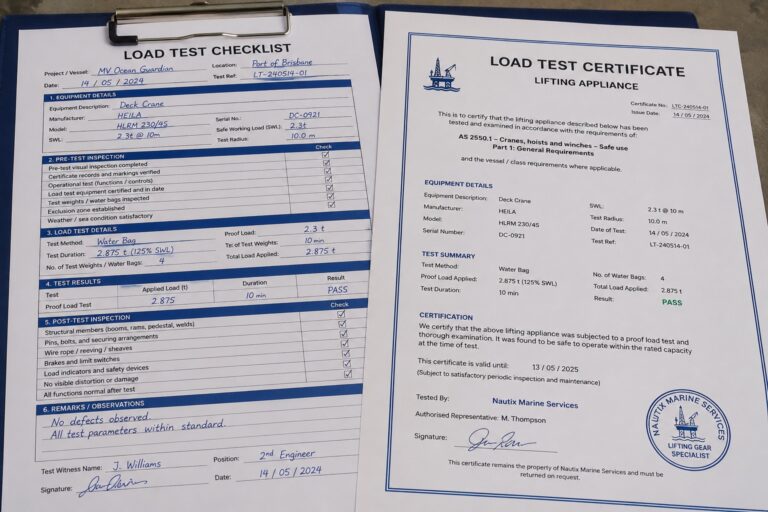
A crane can look serviceable on deck and still fail where it matters – under verified load, with documented evidence, against the standard that applies to the vessel. That is why ship load test certification is not just a paperwork exercise. It is the formal proof that lifting appliances and associated gear have been tested, examined and certified for safe operation within the required limits.
For vessel owners, managers and offshore operators, the issue is straightforward. If the lifting asset is not properly tested and certified, you are exposed on three fronts at once: personnel safety, regulatory non-compliance and operational delay. A missed certificate, an overdue test or poor documentation can quickly become an AMSA finding, a class query or a chartering problem.
What ship load test certification actually covers
Ship load test certification applies to lifting appliances and lifting gear installed or used onboard vessels. That may include deck cranes, provision cranes, engine room lifting arrangements, davits, gangways with lifting function and loose lifting gear where certification is required. The exact scope depends on vessel type, flag, class rules, equipment design and intended use.
At its core, certification confirms three things. First, the equipment has been subjected to the required proof load or functional load test. Second, it has been examined by a competent and authorised party. Third, the results have been recorded in a form acceptable to the relevant authority, class society or client standard.
This distinction matters because testing alone is not certification. A vessel may complete a physical load test, but if the method, witness requirements, calibration traceability or reporting do not meet the applicable standard, the outcome may not stand up during inspection. In practice, that means operators need more than a test crew. They need a provider who understands the compliance pathway from planning through to accepted documentation.
Why certification is scrutinised so closely
Lifting incidents offshore and at sea are rarely caused by one obvious failure. More often, they follow a chain of smaller issues – degraded wire, inaccurate load indication, deferred maintenance, damaged sheaves, structural fatigue or undocumented modification. Load testing is one of the few points where those risks are checked in a controlled and measurable way.
Regulators and class bodies scrutinise ship load test certification because lifting appliances are safety-critical systems. They are used around crew, stores, machinery and in many cases over the side. When they fail, the consequence can extend beyond damage to the asset. It can interrupt cargo handling, offshore support operations, emergency response capability or lifesaving arrangements.
For Australian operators, the compliance context also matters. AMSA readiness is not limited to whether equipment appears operational. Inspectors want to see whether required examinations, test intervals and certificates align with statutory obligations and the vessel’s actual condition. If the paper trail does not match the onboard reality, the vessel can face defects, delays or further scrutiny.
When a vessel needs ship load test certification
There is no single answer that covers every vessel, because timing depends on the equipment and the governing rules. New installations typically require initial proof load testing and certification before the equipment is placed into service. Periodic retesting may then be required at defined intervals, after major repair, after structural alteration, after wire renewal in certain cases or following any event that could affect safe working condition.
This is where operators can get caught out. Some assume routine annual inspection is enough for all lifting equipment. It often is not. Others rely on historical certificates without checking whether the equipment configuration, safe working load markings or operational use have changed. A crane used occasionally for stores has a different risk profile from one supporting offshore project activity, but both still need to meet the applicable testing and certification requirements.
If there has been an AMSA defect, class recommendation, incident, overload event or extended period out of service, it is worth reviewing certification status before the next mobilisation. Waiting until a pre-port state control check or class attendance is usually the most expensive time to find a gap.
The practical process behind compliant certification
A proper certification process starts well before the test weights arrive. The equipment must be identified correctly, previous certificates reviewed, drawings or manufacturer data checked where available, and the applicable standard confirmed. This upfront work prevents a common problem: testing the right asset in the wrong way.
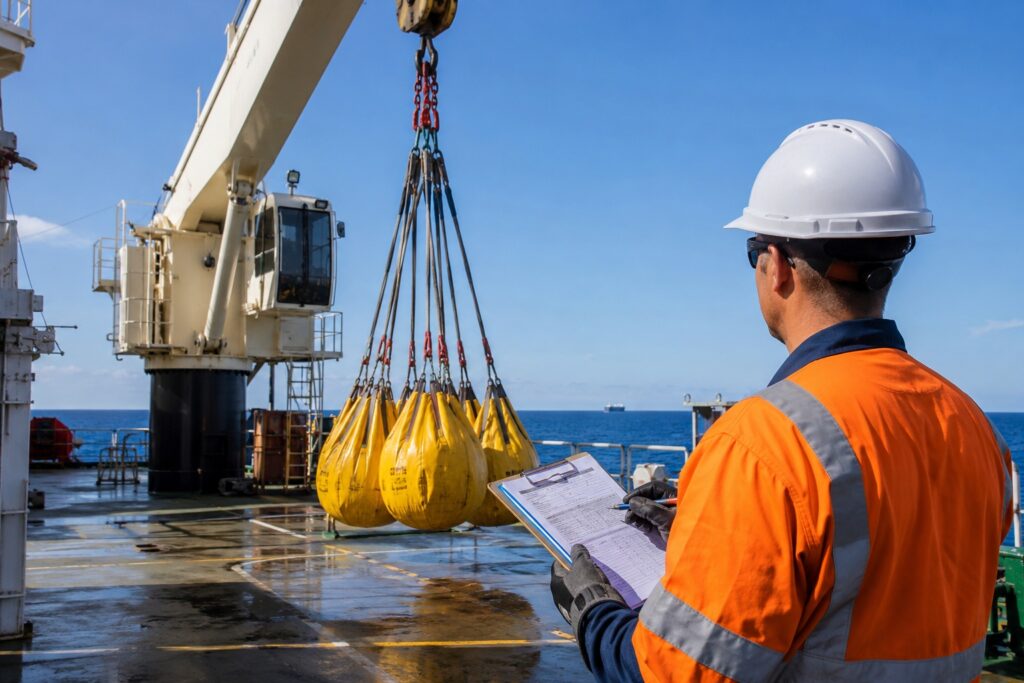
The test itself must use calibrated equipment and a method suited to the lifting appliance. Depending on the arrangement, that may involve water bags, certified test weights or a controlled alternative approved under the relevant framework. The loading sequence, test radius, boom position, hoisting function and safety device checks all need to reflect how the appliance is designed to operate.
After the load test, the examination is just as important as the lift. Structural components, pins, sheaves, brakes, wire rope condition, limit devices and mounting arrangements need to be assessed for signs of distress, deformation or abnormal behaviour. A successful lift does not automatically mean the appliance is in acceptable condition.
Documentation then closes the loop. Certificates, test reports, calibration evidence and any defect observations should be clear, traceable and suitable for presentation to AMSA, class or client representatives. If repairs or limitations are identified, they should be recorded in a way that supports rectification rather than creating ambiguity.
Where operators often run into trouble
Most certification issues are not dramatic. They are administrative or procedural gaps that become serious because they are discovered at the wrong time.
A frequent problem is incomplete asset history. Equipment may have been transferred between owners, re-rated, modified or repaired without the supporting documents being carried forward. Another is using a contractor who can perform the physical test but cannot issue certification aligned with the vessel’s compliance framework. That can leave the crew with a report that looks useful but does not satisfy the attending authority.
There is also the question of access and operational timing. Shipboard testing often happens during short port windows, alongside bunkering, stores, class attendance or other maintenance. If the job is not planned around vessel operations, the result can be aborted testing, safety conflicts or partial documentation that needs to be revisited later.
For offshore and commercial vessels, the real cost is not just the invoice for retesting. It is schedule disruption, delayed departure, standby time and the risk that one unresolved lifting certificate triggers wider inspection attention.
Choosing a provider for ship load test certification
Not every marine contractor is set up for certification work on active commercial vessels. The right provider needs technical capability, but also procedural discipline. That means understanding lifting equipment behaviour, test methodology, Australian regulatory expectations and the reporting standard needed for acceptance.
It also helps to work with a team that can move from inspection to rectification where required. If a load test identifies worn wire, brake performance issues, certification gaps or structural concerns, you do not want a long gap between diagnosis and action. An end-to-end service model reduces downtime and keeps responsibility clear.
For operators working across Australian ports and offshore campaigns, responsiveness is not a nice extra. It is part of compliance management. A provider that can attend quickly, coordinate the test, issue the right documentation and support defect close-out can prevent a minor issue from becoming an operational stoppage. That is where a specialist marine partner such as Nautix Marine adds value – not simply by applying the load, but by keeping the vessel inspection-ready and commercially moving.
Certification is about more than passing the day
The best operators do not treat ship load test certification as an isolated event. They use it as a control point in a broader lifting integrity programme. When certificates, inspection intervals, maintenance history and equipment condition all line up, vessel teams spend less time reacting and more time operating with confidence.
That approach also creates better outcomes when something is not right. If a crane fails a test or a defect is identified, a well-managed certification process gives you a clear technical basis for repair, re-test and return to service. There is less argument, less delay and less exposure.
In commercial marine operations, certainty has real value. When your lifting assets are properly tested, competently examined and backed by accepted certification, you are not just satisfying a requirement. You are protecting people, preserving schedule and giving every inspector one less reason to hold the vessel up.
GET A LOAD TESTING QUOTE
Need Marine Load Testing?
✔ Ship Cranes
✔ Gangways
✔ Accommodation Ladders
✔ Davits
✔ Lifting Equipment
Need Help? Talk to Nautix Marine